
Last week, after a nine-month gestation period, the ‘Independent review into prevalence and support for mental health conditions, ADHD and autism’ delivered its final report. The Review was commissioned last December by former Secretary of State for Health and Social Care, Wes Streeting, at a time when the public and political debate about “overdiagnosis” was at its peak. Review chair Prof Peter Fonagy and vice-chairs Prof Sir Simon Wessely and Prof Gillian Baird were asked to look at trends in prevalence over the last 30 years, the factors underlying the trends, how services are organised, as well as ways to prevent mental ill health, create resilience and improve early intervention.
The review is clear that mental distress and common mental health problems, particularly anxiety and depression, have increased substantially, especially for young people. The co-occurrence of mental health problems with ADHD and autism than was previously realised, creating additional complexity and acuity. Young people are dealing with a combination of interacting social, cultural and environmental challenges not experienced by previous generations. The impact of increased prevalence is falling on individuals, families, carers and society as a whole, with an economic cost estimated at around £300bn a year.
Exploring what lies beneath the statistics
Mind’s Chief Executive Sarah Hughes was a member of the steering group for the Review and led a topic group, alongside the brilliant Matthias Pierce from University of Manchester, which dug deep into the drivers of the increase in prevalence over the last three decades, getting beyond the simplistic and sensationalist newspaper headlines to uncover a complex picture of interacting factors.
To complement the literature review and data analysis conducted by Matthias and his team, Mind conducted a series of focus groups segmented by age cohort to explore the factors that influenced the mental health of different generations as they were coming of age in the 1990s, 2000s, 2010s and 2020s. For the adult groups, we recruited people who had regular contact with young people either personally or professionally, which offered an opportunity to reflect on what had changed over time.
The research identified four mechanisms that are likely to be driving the change - reflected below in quotes from the focus groups we conducted:
1) Greater uncertainty and insecurity, including poverty, financial insecurity, unemployment, housing pressures, the cost of living, climate concerns and political instability
“Thinking about the last 30 years, you know, we had the kind of late 90s, early noughties of the Blair government, which had a really fast economic growth and housing value just skyrocketed, but wages didn’t. And we’ve got this kind of disparity that’s like come out, it’s even worse now. I mean, my wage is still probably the same as what it was 20 years ago in real terms, what I can afford and that gets passed down to what I can afford to give my child.” Focus group participant age 46-55
“It sounds a bit cliche or something, but hope – as in knowledge that the future is going to be okay because with the news, with cost of living, with all of these factors affecting mental health, I don’t think a lot of people have faith that it’s actually going to be okay, or that they’re going to, in five years, have any opportunities or have any kind of security.” Focus group participant age 14-25
2) Greater evaluation and comparison, including educational pressure, social media and bullying
“When I was growing up, you would compare yourself to your friend or your classmate. These days you’ve got millions of people online who have incredible lifestyles that are just not achievable.” Focus group participant age 36-45
“I’d say in general, the GCSE and A-level reforms that happened a few years ago put pressure on more young people. There’s more pressure to go to university because in the news you see people can’t get jobs, so you put pressure on yourself and maybe your parents put pressure on you to go to university.” Focus group participant age 14-25
3) Less belonging, driven by reduced youth and community provision alongside rising loneliness and social isolation
“When I was younger, we had a youth club where we spent loads of time. We had somewhere to go, somewhere to be with friends. It’s sad that young people today don’t have that. It almost feels like they’re forced to socialise on screens instead.” Focus group participant age 46-55
“I think reduced community connection leads to isolation and then this makes many mental health problems worse. For example, when community spaces close, people don’t bump into others naturally. Plus, if you’re already struggling, you’re less likely to reach out, so isolation becomes a cycle. Peer support and informal communities can prevent things from escalating but then there’s less peer support around now, and fewer community anchors that used to give people routine and belonging.” Focus group participant age 36-45
4) Fewer opportunities for rest and recovery, with more time spent online and less opportunity for physical activity, time in nature, play and uninterrupted sleep.
“There is so much pressure within the education system. My son is 5, but on his first day in reception he was screened to see if he was meeting the standards of being able to write. We were out playing, I remember playing out in the forest. It’s like kids can’t be kids anymore. They don’t play. There’s not that freedom.” Focus group participant age 26-35
In the face of these challenges, the Review concludes that it is not surprising that more young people are developing mental health problems. Indeed, Prof Peter Fonagy has suggested the impact could have been worse were it not for the resilience young people have shown: “I’m in awe of the way they have adjusted to an environment that is far more difficult than I ever had to face.” There now needs to be an end lazy commentary about “snowflakes” and young people “pathologizing the everyday ups and downs of life”. Instead, our focus must be on action to address those challenges upstream alongside ensuring they can get the support they need, when they need it.
Changing the model of support
The Review calls for a much greater focus on upstream prevention, including re-investing in youth services, play, green spaces and creative arts, better regulation of online environments, improving people’s experiences in schools and supporting people to have appropriate housing, stable employment and financial security.
It also states that in the face of increased need for support, the current system is not meeting people’s needs. While there has been some additional increase in investment in services, it has not kept pace with demand. As a result, people are facing long waits for support and are coming to harm while they wait. Support across health, care, education, employment and benefits remains fragmented, creating distress for people and inefficiency across the system.
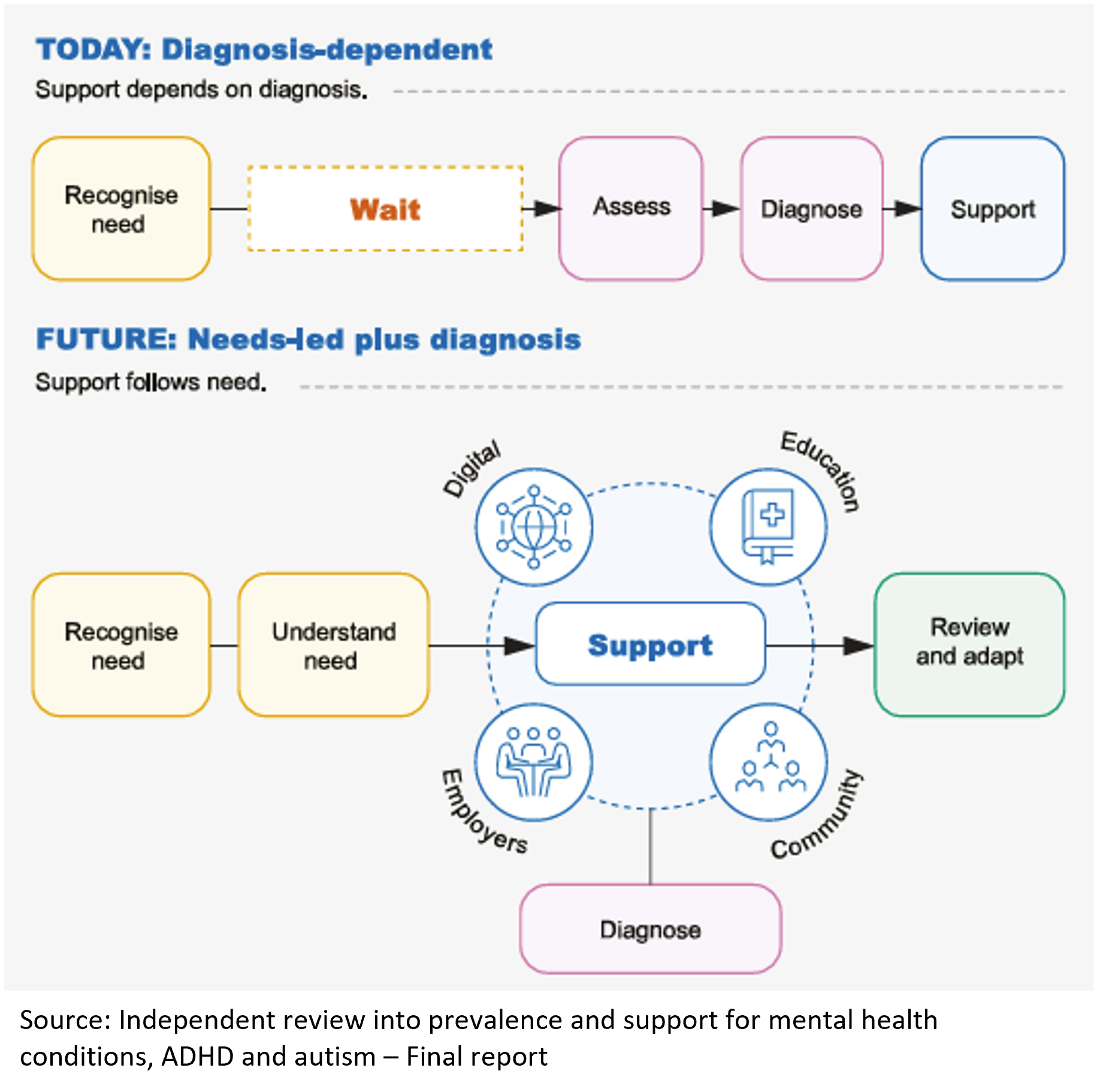
The Review calls for a system based on recognising needs sooner and intervening earlier. It says the current system too often follows a sequence of “wait, assess, diagnose then support”. The new pathway proposed by the Review first seeks to establish need, understand what is happening, begin appropriate support, establish diagnosis where it changes treatment or entitlement and review and adapt support as circumstances change. Under this system, support should be matched to need, functioning and participation (encompassing not just work and education, but also ability to participate in community, relationships and family life), not diagnosis alone.
At Mind, we have begun to set out what this kind of system could look like in our recent Opening Doors report. The report identifies the principles that underpin great care – person-centred, accessible, enabling of learning and improvement, safe and based on early intervention – and calls for a same-day open access system, where reaching out for help is met with an immediate, meaningful response, not a waiting list or a referral into an opaque pathway. Anyone can access a conversation with a professional, who will take the time to properly understand the person’s needs and circumstances. This is not a gatekeeping exercise – it is a therapeutic intervention that, for some people, may be all they need. For others, it will be the foundation for identifying the further support they need, whether that is clinical care, peer support, help with housing or employment, or a combination of these.
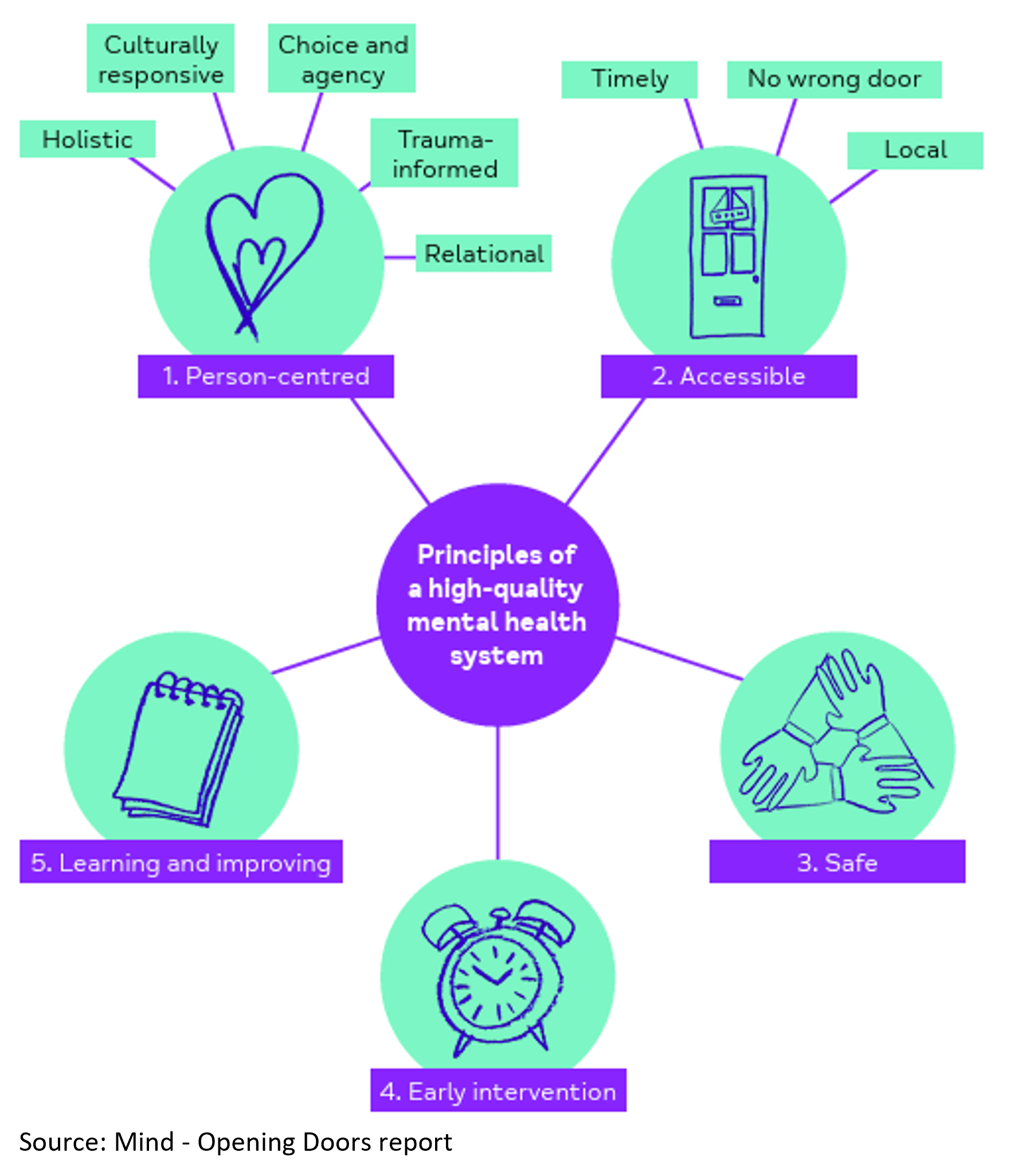
People with mental health problems tell high-quality care is built on trusting, compassionate and collaborative relationships. It values continuity, listening and shared decision-making, recognising that human connection is fundamental to recovery. While digital and AI-enabled will have a role to play in expanding access, through online therapies and tools, people should always have a genuine choice in how they access support, with digital solutions supplementing rather than replacing local services that are physically accessible to all residents. Digital solutions must also be underpinned by inclusive design and adequate digital literacy support
“Out of all my experiences with different healthcare professionals, the ones that really stick out are not necessarily the people that are the most educated about what I suffer with or anything like that. They’re just the people that just sit and properly listen.” – Adult with lived experience, Opening Doors report, Mind 2026
With a new 10-year mental health strategy for England due before Christmas, there is a golden opportunity to make same-day open access a reality. We want the strategy for England to mirror the ambition to transform the mental health system based on this principle that the Welsh government has shown. We now look forward to working with the government to make our shared ambition of better, earlier, more open access support for mental health a reality.